How to read Tarot for yourself
Reading Tarot is a practice you can learn by exploring images, meanings and questions. This guide covers framing a question, shuffling and interpreting a beginner spread.
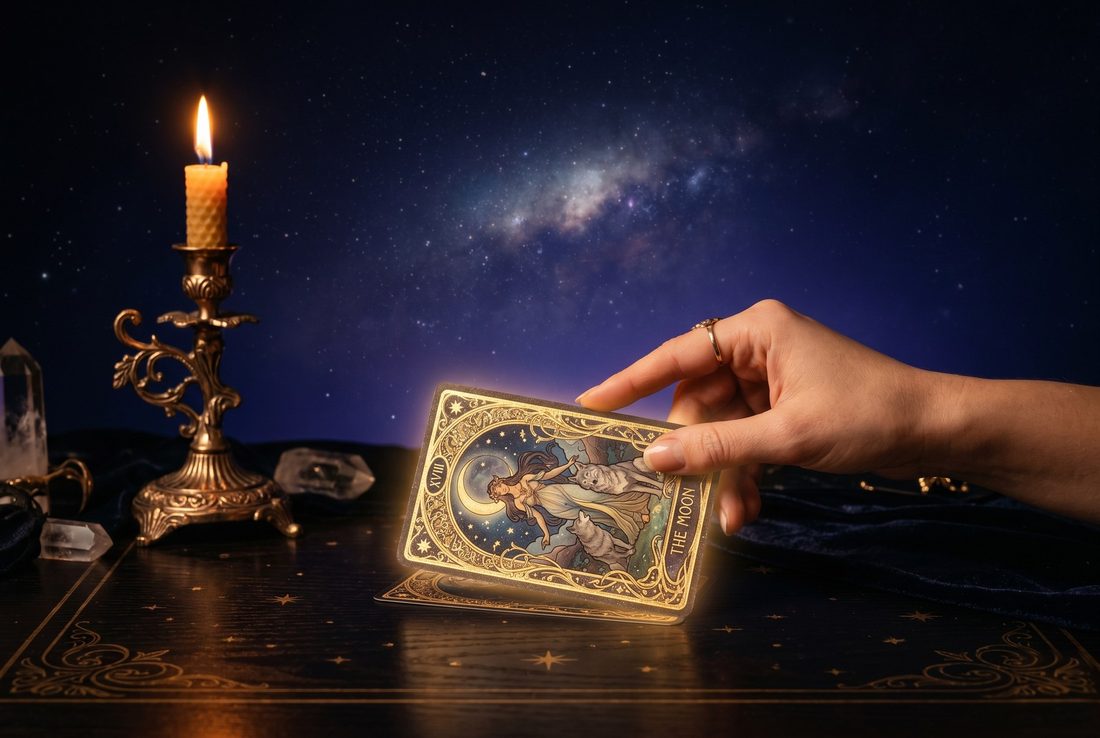
Can you read Tarot for yourself?
Yes. Your knowledge of your own situation provides context, and you can notice which themes resonate. It also creates a risk of seeing only what you want to see. Ask an open question and resist repeatedly drawing until you get a preferred card.
What you need for a reading
| What you need | Why it helps |
|---|---|
| A Tarot deck | 78 cards: 22 Major Arcana and 56 Minor Arcana. A standard deck such as Rider–Waite–Smith is a practical starting point |
| A quiet place and some time | A calmer setting helps you pay attention to the images and your responses |
| A focused question | A clear question gives the interpretation useful context and keeps your reflection focused |
| A notebook | Record your spreads and impressions, then review both the connections and the parts that did not fit |
| Openness to reflection | Some themes may feel uncomfortable. Choose a time when you can consider them without treating a card as an instruction |
Framing a useful question
Think of the claim that a reading is 80 percent about the question as a reminder, not a measured statistic. Questions beginning with “what” or “how” often invite more useful reflection than requests for a date or a name. Tarot offers symbolic themes rather than verifiable answers about future events.
Questions that invite useful reflection
“What am I overlooking in this situation?” “What supports me, and what gets in the way?” “What themes are present in this relationship?” “What should I consider about this path?” “What am I ready to let go of?”
Questions that give less room to explore
“When will they call?” asks for a date the cards cannot establish. For a choice between jobs, explore each option and use practical information to decide. “Do they love me?” cannot reveal another person's mind. “What will happen?” is too broad to give a reading much context.
Shuffling the cards
There is no single required method. You can shuffle the deck in your hands, spread the cards face down and mix them on a table, or cut the deck into several piles and put it back together. Choose a method you can use comfortably while keeping your question in mind.
Simple beginner spreads
Daily card (1 card)
Draw one card and ask what theme you could reflect on today. Record the image and your response, then review it in the evening. Notice mismatches as well as apparent connections. Regular practice helps you learn the cards without needing to memorise everything at once.
Three cards: past, present and future
This traditional spread forms a short story: the background, the present situation and a possible direction to consider. Treat the future position as a reflective possibility, not a fixed outcome.
Five cards: a fuller context
Position 1: the situation. Position 2: what supports you. Position 3: what gets in the way. Position 4: what you may be overlooking. Position 5: a suggestion or possible direction. This format offers several perspectives on a complex question.
Reading the cards step by step
First, look at a card before opening a guide: what stands out, and what do you feel? Then compare a traditional meaning with its position in the spread. The same card can suggest different themes under “support” and “obstacle”. Finally, view the whole spread: which suits recur, are there Major Arcana, and what connects the images?
How often can you do a reading?
There is no fixed rule, but repeated draws for the same question can become confusing or encourage searching for a preferred answer. Record the spread, allow time for reflection and return when the situation or your question has changed. You can try a spread in our online Tarot service.
Try an online Tarot reading
Choose your cards and explore a reading connected to your question.
Try a spreadWhere should a Tarot beginner start?
Try a daily card. Each morning, draw one and ask what theme you could reflect on today. Write down your response and review it in the evening, noting both connections and things that did not fit. Regular practice helps you become familiar with the cards.
Do I need to memorise all 78 cards?
No. You can begin with the 22 Major Arcana and their broad themes, then learn the Minor Arcana gradually. Look at each image yourself before checking a guide. Repeated practice will help the meanings become familiar.
Do I need a special deck?
A standard 78-card deck is a practical starting point. The Rider–Waite–Smith deck has illustrated scenes and many accompanying guides. Choose a deck whose images you enjoy exploring.
What if I do not understand a card?
Pause to look at the image and note your first response. Read a traditional meaning and consider how it relates to your question. Record the spread and revisit it later, staying open to interpretations that do not fit as well as those that do.