What is a birth chart?
A birth chart maps the sky for a birth date, time and place. Astrology interprets it symbolically in relation to personality and life themes. Here is a clear introduction to its main parts.
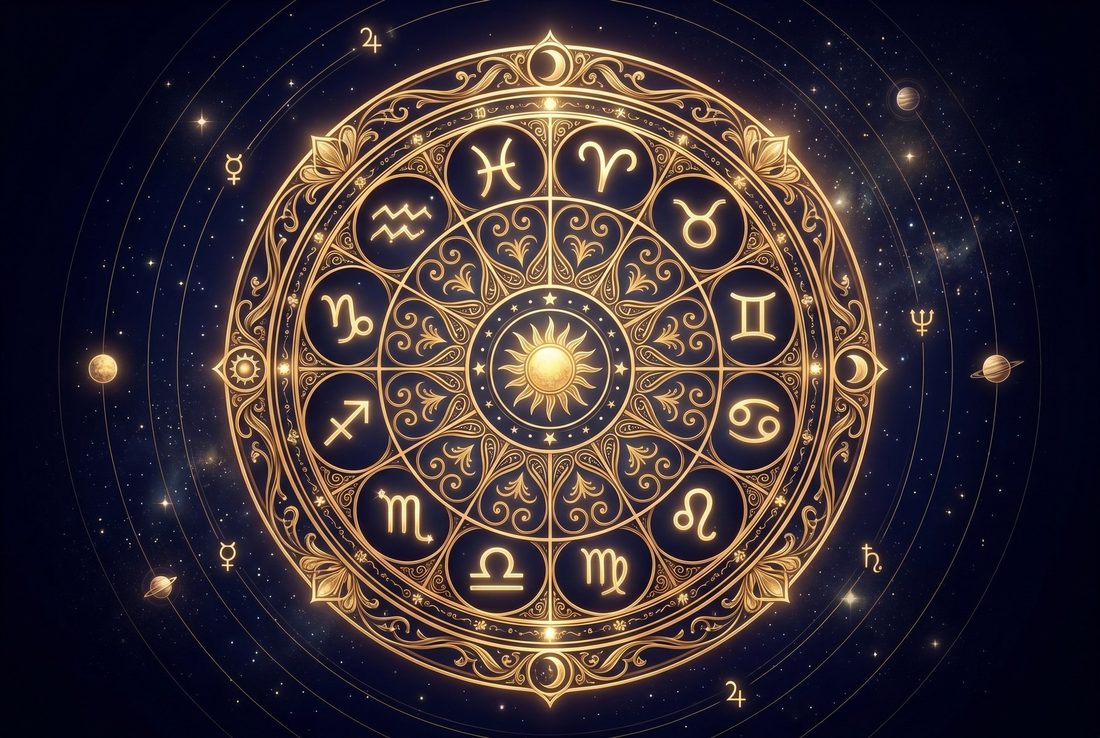
A birth chart records celestial positions and the local horizon for a date, time and place. It shows planets in signs and degrees, with a particular sign rising in the east. Astrology uses these calculated positions for symbolic interpretation; the calculation itself does not validate claims about personality or destiny.
Start by learning the chart's main parts and a useful reading order. You can explore the basics without taking in every detail at once.
What you need to create a full chart
A full birth chart uses three pieces of information.
Date of birth
The date establishes the general planetary positions. It is essential, but does not provide every detail of a full chart by itself.
Exact time
Time is especially important for the Ascendant and houses. Even a relatively small difference can change their positions significantly.
Birthplace
Location connects the chart with the local horizon and helps establish the correct time-zone context.
The parts of a birth chart
Astrological readings combine four main layers. Planets represent different themes or functions. Signs describe the traditional style of their expression. Houses, twelve in total, are associated with areas such as relationships, resources, work and family. Aspects are angles between planets, traditionally interpreted as different kinds of connection or tension.
Traditional planetary themes
| Planet | Traditional themes |
|---|---|
| The Sun | Identity, self-expression and motivation |
| The Moon | Feelings, inner experience and emotional needs |
| Mercury | Thinking, speech, communication and learning |
| Venus | Love, resources, taste and values |
| Mars | Energy, determination and action |
| Jupiter | Growth, opportunity and worldview |
| Saturn | Discipline, limits and responsibility |
| Uranus | Change, freedom and unexpected perspectives |
| Neptune | Imagination, intuition, spiritual themes and uncertainty |
| Pluto | Transformation, power and deep change |
Where to begin reading
Start with the Sun, Moon and, if the time is known, Ascendant. Their traditional themes are identity, inner experience and outward presentation. Next, explore Mercury, Venus and Mars through thinking, values and action. Add houses and aspects gradually to connect the interpretation.
Common beginner mistakes
Common mistakes include treating the Sun sign as the whole chart, fearing challenging aspects and relying on houses when the birth time is unknown. Keep uncertain details open and use the interpretation as reflection. You can explore calculated planetary positions on our Birth chart, and read more about zodiac signs and the Destiny Matrix.
Explore the sky on your birth date
Enter your date to calculate planetary positions and explore their symbolic interpretations. A date-only result is not a precise full birth chart.
Create my chartIs an exact birth time needed?
For a full birth chart, yes. The Ascendant and house positions depend on time and location and change through the day. Without a time, a date-based chart can show approximate planetary positions, but houses and an exact Ascendant are uncertain.
Can I create a chart without a birth time?
Yes. A midday chart uses a chosen time to estimate planetary positions for the date. It should not be treated as a precise birth-time chart, and its houses and Ascendant are not reliable for your birth.
Which matters more, the Sun or Moon sign?
Astrological readings consider them together. The Sun symbolises identity and motivation, while the Moon represents emotional needs and inner experience. They offer different themes to explore.
Is it difficult to read a birth chart yourself?
You can begin with the Sun, Moon and Ascendant, then study houses and aspects through practice. Distinguish a full birth chart from a simpler birth-date numerology reading when choosing a service.